


Seeds of Hope in Bloom: Crucified Woman
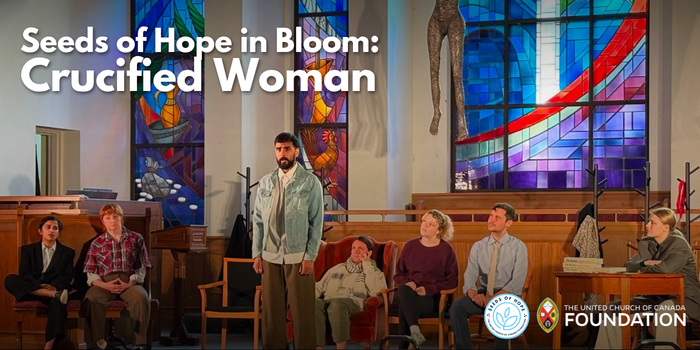
With support from a $5,000 Seeds of Hope grant from the Living Spirit Fund, College Street United Church in Toronto brought Crucified Woman, a new play by Emmanuel College alumnus Rev. Jeffrey Dale, to the stage as part of the 2026 Toronto Fringe Festival.
Inspired by the iconic Crucified Woman sculpture at Emmanuel College, the play explores faith, artistic censorship, and freedom of expression. It weaves together the history of the sculpture with the story of Canadian author Margaret Laurence, whose own experiences with censorship and book banning shaped her understanding of artistic freedom and faith.
From July 1-11, 2026, over 500 people attended the production at College Street United Church.
Sculpting a story
The story of Crucified Woman began through Bloor Street United Church before the sculpture eventually found its home at Emmanuel College.
For Margaret Laurence, the sculpture held an incredibly personal spiritual significance. A member of Lakefield United Church at the end of her life, Laurence wrote about Crucified Woman in her autobiography Dance on the Earth. She described being so moved by the sculpture that it helped her believe in God.
The connection between the sculpture and Laurence became the foundation for Dale’s play.
Through the two stories, Crucified Woman invites audiences to consider questions about faith, feminist spirituality, artistic expression, book banning, and the church’s relationship with the wider community.
For Dale, the production also marked an important milestone in a project that had been nearly a decade in the making. Extensive interviews, research, writing, and rewriting had gone into the play. The 2026 Toronto Fringe Festival was the first time the work was experienced by a live audience.
A story that sparked conversation
The production attracted people with many different connections to the stories being told.
Some audience members had personal connections to the United Church of Canada. Others knew Margaret Laurence or were familiar with her work. Others came with no knowledge of either story, and left eager to learn more.
After each performance, audience members stayed to chat with the cast and crew, which created opportunities for conversations and connection beyond the performance material.
One response came from Rev. Dr. Joan Wyatt, who attended a performance. Wyatt had been instrumental in bringing the Crucified Woman sculpture to Emmanuel College and was one of the first people Dale interviewed when he started researching the play.
After seeing the production, she said: “I could not miss the opportunity to see this play. As I lived it.”
For Dale, her response captured one of the most important reasons to tell stories rooted in the history of the Church.
When people have lived part of a story themselves, bringing it to the stage carries a responsibility to tell it with care, respect, and integrity. It also creates an opportunity to preserve stories that might otherwise be forgotten, while allowing them to speak to communities today.
The audience response also showed that the play has room to grow. One audience member shared that the production inspired them to read Margaret Laurence’s work, while another praised the writing and performances and suggested that the play deserved a larger production.
Even criticism became an opportunity for reflection. Not every audience member immediately understood the historical significance of Crucified Woman within Toronto or the United Church of Canada. This prompted the production team to review how the two stories connect and who the play might reach in future productions.
The church as a theatre
Presenting the play at College Street United Church created its own unique experience.
A church is not a conventional theatre, and there were practical challenges. Fringe venues are spread throughout Toronto, and because College Street United Church was outside the area where many Fringe productions were concentrated, the production relied heavily on word of mouth.
A limited production budget also meant that advertising had to be reduced.
But the unconventional venue became part of what made the production meaningful.
Many of the conversations and scenes in Crucified Woman take place in church settings. Presenting the play inside a church allowed audiences to experience the story in a space that carried its own history and meaning.
The intimacy of the space also created a close connection between the performers and audience.
Although there were some challenges, including creaky pews, the experience showed College Street United Church that its building could successfully serve as a theatre space.
The congregation is already discussing another theatrical production.
Theatre as ministry
The project reinforced an important lesson for College Street United Church: the arts can, and should be, be an active part of the Church’s ministry.
Theatre provides an opportunity to explore faith, history, tradition, and difficult questions in an immediate and embodied way. Like worship, it can invite people into another person’s story, encourage reflection, and create space to wonder about the presence of the divine.
Crucified Woman also encouraged the congregation to look again at its own history.
The play explores themes that can sometimes feel as though the Church has moved beyond them. The story asks audiences to consider how the past continues to speak to the present, including the ways people experience suffering, censorship, injustice, and exclusion in the world today.
By looking honestly at its history, the Church can ask how far it has come, where it’s fallen back, and what it is being called to do now.
Continuing the story
The Toronto Fringe Festival was not the end of Crucified Woman. An updated version of the play will receive another staged reading in the fall, after which the production team hopes to submit it to theatres for future productions.
The Seeds of Hope grant was particularly important in helping the production secure a replica of the Crucified Woman sculpture, created by Toronto artist and United Church of Canada member Kristyn Watterworth.
The replica was so similar to the original that audience members wondered how the production team had managed to bring the actual sculpture into the church. It became a powerful visual and symbolic connection between the play and the history that inspired it.
The project also strengthened relationships between College Street United Church, Bloor Street United Church, and Emmanuel College, while creating new connections with people from the wider community.
Audience members have shared that they’ve started reading Margaret Laurence’s work, discovering or reconnecting with her writing.
What began as a decade-long writing project has now become a larger conversation about the history of the United Church, the role of artists and the arts in the church, and the stories communities choose to preserve.
For College Street United Church, Crucified Woman demonstrated that theatre can be a form of ministry, creating the space to remember, question, connect, and explore where faith meets the world around us.
Interested in applying for a Seeds of Hope grant or other grants that help bring stories of spirituality to life? We are now accepting applications. Applications are due October 15, 2026.